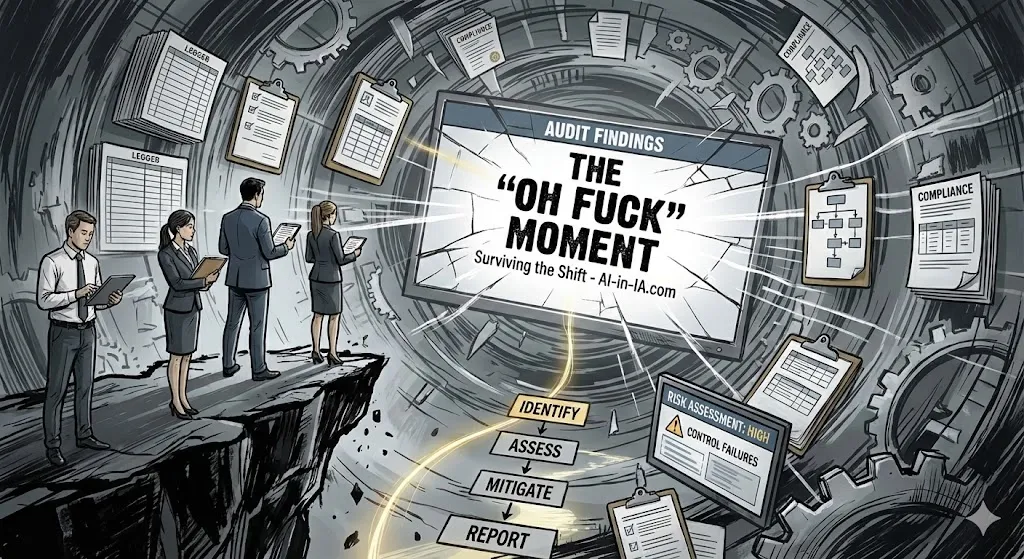
I need to tell you about the moment the floor dropped out from under me.
I’ve spent thirteen years in audit. External audit at a Big Four firm. Internal audit across multiple industries. Consulting engagements. I have the certifications, the late nights, the hard-won professional judgment that only comes from years of doing the work. I was good at my job.
Then I built something that broke my brain.
What I Built
Over the course of a week—one week—I created an AI orchestrator that walks through the entire internal audit process. Scoping. Risk assessment. Control evaluation. Evidence analysis. Finding generation.
It’s messy. It’s ugly. The interface is rough. But it works.
I didn’t write code. I don’t know how to write code. I used AI tools to build it—feeding prompts into Cursor, iterating with Claude and ChatGPT, stitching together workflows that would have required a development team and months of budget approvals just two years ago.
And when I ran it against real audit scenarios, it performed. Not perfectly. But competently. Disturbingly competently.
That was my Oh Fuck moment.
Not watching a demo. Not reading an article about AI disruption. Building the thing myself and realizing: I am now the bottleneck in my own process.
Thirteen years of professional development. Years of studying standards and frameworks. Exposed as… what, exactly? Pattern matching? Comparing conditions to criteria? The thing I’d been doing manually, transaction by transaction, was suddenly something a system could do continuously, without getting tired or making the kinds of mistakes humans make when they’re on their fifth hour of sample testing.
I closed my laptop and stared at the wall for a long time.
The Shift Is Real
Here’s what I need you to understand: this isn’t hype.
I’ve sat through the corporate AI presentations. I’ve heard the vendor pitches. I’ve read the breathless LinkedIn posts about how “AI will transform everything.” It’s easy to dismiss that noise. I dismissed it too.
But I’m not talking about theoretical disruption. I’m talking about something I built, myself, in my spare time, that does a significant portion of what I get paid to do.
If I can do this with no technical background, what happens when actual developers start building audit tools? What happens when companies realize they can do continuous monitoring instead of paying for periodic audits?
The traditional audit model—sampling transactions, testing controls manually, producing backward-looking assurance reports—that model is standing in the blast zone. The value of checking boxes is collapsing.
This isn’t coming in five years. It’s happening now. The only question is whether you see it before it hits you or after.
Why I’m Writing This
I don’t have answers yet. I want to be clear about that.
I’m not here to sell you a course or tell you I’ve figured out the future. I haven’t. I’m in the middle of the same uncertainty you might be feeling—or will feel soon.
But I’ve decided to document the journey anyway.
Because sitting alone with this realization is worse than processing it out loud. Because writing forces clarity. Because if I’m going to figure out what comes next, I might as well share what I’m learning along the way.
And honestly? Because I think our profession needs people talking openly about this instead of pretending everything is fine.
The permission slip isn’t coming. Your company’s AI strategy will take years. Your professional body’s guidance will be cautious and backward-looking. By the time there’s a sanctioned path forward, the people who started early will be years ahead.
So I’m starting now. Uncertain. Uncomfortable. But moving.
What’s Coming
This is the first post in a series where I document what I’m building, thinking, and discovering as I navigate this shift. No corporate sanitization. No pretending I have it all figured out. But I’m not starting from zero either.
The audit orchestrator I mentioned? That’s just one of several projects I’ve been developing. I’m building tools for continuous control monitoring—systems that don’t wait for the annual audit cycle but watch for control failures in real-time. I’m experimenting with AI agents that can parse unstructured evidence, map it against control frameworks, and flag anomalies that would take human auditors days to find. I’m working on approaches to audit AI systems themselves—because someone needs to figure out governance for autonomous decision-making, and it should be us.
Beyond the tools, I’ve developed a clear perspective on where this profession is heading:
-
From assurance to resilience. The value of backward-looking “did we comply” reports is evaporating. The future is forward-looking: identifying risks before they materialize, stress-testing systems, building organizational resilience. Auditors who cling to compliance checking will be automated. Auditors who become resilience architects will be indispensable.
-
From executor to orchestrator. The auditor as someone who personally performs every test is finished. The auditor as someone who designs, deploys, and oversees AI agents that perform thousands of tests continuously—that’s the model that survives.
-
From knowledge hoarder to judgment provider. When AI can recall every standard and framework instantly, memorizing COSO or IIA standards isn’t a competitive advantage. The value shifts to judgment under ambiguity, to asking the questions nobody else is asking, to seeing the risks that aren’t in the data yet.
I’ll be writing about all of this. The projects I’m building. The failures along the way. The vision for what AI-native audit actually looks like. And the harder questions: What happens to the profession? What skills survive? Who audits the AI when autonomous systems are making decisions at scale?
If you’ve had your own Oh Fuck moment—or if you’re starting to feel one coming—follow along.
I’ll be here every week.
Subscribe at ai-in-ia.com to follow the series.